Monday, November 06, 2006

Halloween

I did as usual and wore horns for Halloween this year. These were fairly good, but the effect didn't come of as well as I'd hoped. (The latex didn't blend quite as well with my skin as it could have.) It was however somewhat appropriate; I gave a test to my Algebra students on Halloween. (I gave them candy too. I'm a nice demonic being.) Actually I had three people in my department who did not initially notice that I was wearing horns at all, which makes me wonder.

And of course I got home as soon as possible after my office hours to give out candy to the trick-or-treaters. I wasn't sure how many I would get, and I planned to give some to my students too, so I got a ton of candy. Turns out I'm now left with a ton of candy. (And I didn't even have to hide in my apartment with the lights off eating candy and pretending I wasn't home this year.)

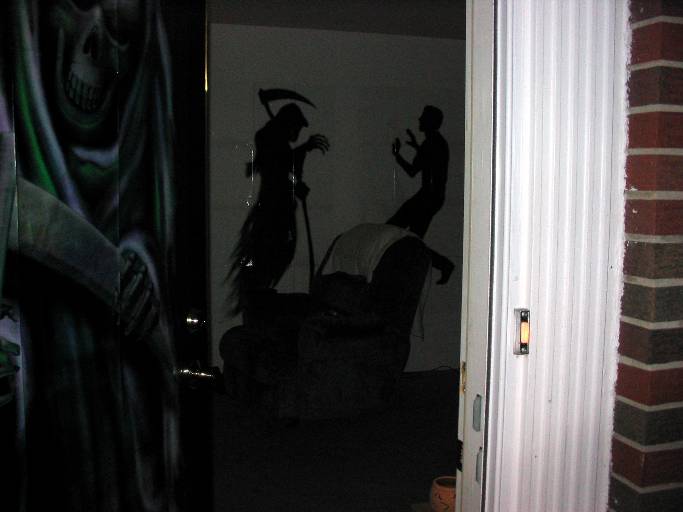
I think I did pretty well with the decorating this year 'though, for having limited time:


I'm not sure you can really see the ghoul on the door, but you can see it in the entry picture below pretty well:


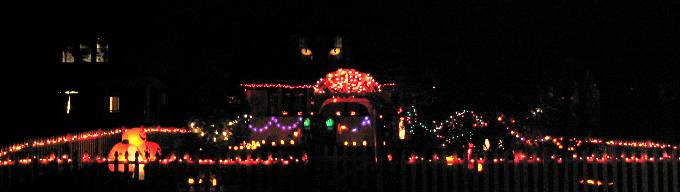
However, I probably have a ways to before I get as good as these people, whose house I passed when leaving the parade party earlier in the week:

Friday, November 03, 2006

Pre Halloween

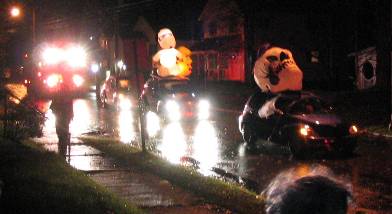
Last weekend I got to see "the largest night-time parade in Pennsylvania", which is a Halloween parade held not far from here. My friends live on the parade route and hosted a party. We alternately stood inside (to get warm) or stood outside and "Woo"-d loudly for whatever group was passing by. (Well, OK, so the county Republican group only got an "Ah, yes.... Hello" and a polite wave from us, but most groups got a "Woo". I'm not sure why, but it was fun. I took a few shots of the parade going by:

Look! Here comes a skull! And Snoopy...


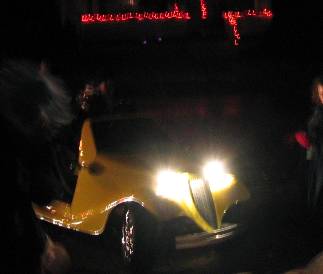
And a tiny car, for some reason:


It was an interesting parade, but sometimes kind of odd. A lot of the parts of the parade seemed to consist of trucks, possibly with a sign or people in the back waving. There were some floats, like this one:


In a number of cases, I couldn't really identify what the float was supposed to represent. (As near as I could tell, there was a float about satellite television at one point.)

There were a number of school marching bands, but they were riding inside school busses and not playing instruments because it was raining.

In any case, the party was fun, I met some nice people, and I even won an award for the best scary costume. I went as a Dementor:


(If you haven't read Prisoner of Azkaban yet, what are you waiting for? :-) )

As it turned out, the hood and gloves were fairly useful when standing outside in the cold.

That Darn Tree


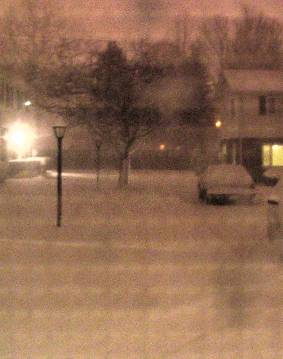
I was pretty worried yesterday when all this white stuff started falling out of the sky. I was thinking it was snow, and went to ask why no one told me it snowed here. He assured me that it was not snow, but rather the leaves of a large, white tree outside. I was much relieved. Thankfully, I won't have to worry about snow this winter.

Unfortunately, he does tell me that the leaves from the tree really pile up like you wouldn't believe all winter long. And those fools at K-Mart don't even know what a "big white tree leaf shovel" is; I'm going to have to settle for what they call a "snow shovel."

Monday, October 23, 2006

The probability is rapidly approaching zero

I've been teaching a class for students planning to be elementary and middle school teachers. Recently, we've been learning about probability. It's a very hands-on class; we meet in a room with nice big hexagonal tables instead of standard desks and do lots of activities. There are two big cabinets filled with wonderful manipulatives. (Note for non-math-education sorts: Manipulatives are physical objects used to teach mathematical concepts. They include items like plastic chips or other counters, different shaped tiles and blocks, and a variety of interesting and creative tools people have come up with. They're a lot of fun to play with.)

Naturally, I try to lead students to discover important results, then hilight and review the results. I'm however realizing that conducting experiments in probability with students who are not so good at following directions is often a recipe for disaster.

A typical day consists of me giving them an experiment to conduct and record results from. (Perhaps rolling dice or flipping coins.) I explain and briefly demonstrate what they are going to do, then set them to collect data. When they are done, I smile like the Buddha and ask them what they found.

They tell me.

Then I say, "You got what? How--wait, what exactly did you do? That can't be right..." Then we proceed to go over the procedure until I find the mistake.

Actually, after the first experiment, I had way to much faith in my students. I recorded their results on the board, looked them over, and declared that this was a very unusual outcome. Something you would only expect to see maybe one in a million times, but nonetheless possible. But after all, I explained, that doesn't mean it can never happen. That was when a student asked "Wasn't that how we were supposed to do it?" And that was when I discovered we had not had a one-in-a-million event, but actually what turned out to be closer to a nine-times-out-of-ten event*: They had written down what they thought should happen instead of what actually happened. This tends to produce results that can politely be termed "wonky".

So new problem: What is the probability that my students will understand and follow all of my directions?
---
* Granted, Terry Pratchett does point out that one-in-a-million chances do come up 9 times out of 10.

Thursday, October 19, 2006

Chaos

The Chaos and Fractals course is on! Apparently, it was even pretty popular at the University level committee, and there is some interest in transforming this into some sort of permanent course offering. Still not much success in finding a book that I really like.

However, I did find the following quote, which I like a lot:

A dictionary definition of chaos is a "disordered state or collection; a confused mixture." This is an accurate description of dynamical systems theory today--or of any other lively field of research.

Morris Hirsch


I'm in the process of trying to collect some more quotes, plus cool pictures and so forth to try and advertise this course. I need to make sure I get sufficient enrollment. Of course, I've always liked the following by Terry Pratchett from the opening of Witches Abroad, but it's too long to fit on a flyer:
...the universe was full of ignorance all around and the scientist panned through it like a prospector crouched over a mountain stream, looking for the gold of knowledge among the gravel of unreason, the sand of uncertainty and the little whiskery eight-legged swimming things of superstition. Occasionally he would straighten up and say things like "Hurrah, I've discovered Boyle's Third Law." And everyone knew where they stood.

But the trouble was that ignorance became more interesting, especially big fascinating ignorance about huge and important things like matter and creation, and people stopped patiently building their little houses of rational sticks in the chaos of the universe and started getting interested in the chaos itself--partly because it was a lot easier to be an expert on chaos, but mostly because it made really good patterns that you could put on a t-shirt.

(So maybe I should call this 'Fermat's Review': "I have found a wonderful quote about this topic, but the flyer is too small to contain it.") If I recall correctly, I did put up this quote at my dissertation defense, 'though. When people ask what I study and I say "Julia Sets", I can always follow up with "the mathematics of T-shirts and coffee cups."

The Pratchett quote also seems to be about as close as we come to a criticism of chaos or fractals. I was hoping for a long list of quotes, at least one of which would have someone kvetching about it being some sort of abomination, but nothing so far. Any suggestions?

Tuesday, October 17, 2006

Algebra Exams

Grading Algebra exams* a few weeks back left me with the conclusion that my students don't understand functions.

For example, they are given that f(x) = sqrt(x) (i.e., "square root of x"; no square root symbols on this keyboard) and that g(x) = x + 1. When asked to find the domain of (f+g)(x), the two most popular answers are "all real numbers" and "sqrt(x)". The following are answers to the domain of the composition f(g(x)):
  • all real numbers
  • all real numbers except x = -1
  • (sqrt(x))(x + 1)(x)
  • {f < x < g}
  • I don't know what I'm doing.
The last answer I can't really argue with. Should I give that a point?

Now, almost two weeks later, I gave the students a bonus quiz as an opportunity to make back some points. After having notice for some time that the quiz would cover the same material they bombed on the test, I'm not sure I see evidence that most students did any better on the quiz. In fact, I saw pretty much the same answers on the quiz.

I'm told that the failure rate for this course is somewhat high, so it seems my results are not atypical. But it leaves me wondering: What goes through the minds of my students? How are they studying? Do they think it's working?
---
*Yes, this is a somewhat math-y post. If you didn't take/don't remember algebra, you may not know why I find these answers funny.

Thursday, October 12, 2006

Longevity Advice from the First Emperor of China

I recently saw an interesting documentary on the first emperor of China. (Which refers to the man who originally unified all the different parts of China. "Unified" being a euphemism for "conquer", or in other words, kill everyone who says you don't get to be Grand High Poo-Bah.) He's responsible for both the Great Wall and the famous terra-cotta warriors, which were set to guard him in the afterlife from all the enemies he made from doing all that "unifying". (Does that make him a "uniter", not a "divider"?)

Interesting thing is, while his tomb was being built, he apparently decided he'd rather just stay in this life, and was in search of immortality. While he searched, he wanted to at least prolong his life as long as possible. Advice from his doctors? Have a lot of sex and eat a lot of mercury. There doesn't seem to be any evidence that the doctors were secretly trying to kill him, either.

What strikes me is this: What will people in 2000 years think of our longevity advice? You know, all this stuff like "exercise", "eat lots of vegetables and fiber", "avoid sugar, salt and fat", etc. What if this is all considered just as ridiculous someday? Who wants to take a risk like that?

Think I'll have a pizza for dinner.